The Friendship Bridge
Three villages cut off every rainy season. One volunteer who flew out alone from western France. Two months of work, 6,500 stones moved by hand, and a diary kept day after day.
Why this bridge
Funding for the crossing had been agreed in early 2007 by another organisation. The promise was never kept. AMBEOKA took the project on itself.
The stakes were not symbolic: without a usable bridge, food from the fields no longer reached the orphanage, and three villages were isolated at every flood. The site lies 28 kilometres from Fianarantsoa, on the road to Toliara, in the commune of Andranorovirato.
In July 2008 a volunteer, Gilles, left for ten weeks. He oversaw the work and sent back to France, almost every day, a report that the treasurer published as it arrived. What follows are the stages of the build.
Day by day
23 JulyLeaving Paris
Flight to Antananarivo, €60 visa on arrival, a few tools bought on the way — a drill, a jigsaw, a plane. Then the coach to Fianarantsoa: leaving at 9am, 550 km, arriving after dark at 7.30pm.
26 JulyFirst visit to the site
In the morning, the AMBEOKA Fianarantsoa committee is formed. At about 11am they leave for the village. They meet the chiefs of the three villages concerned, are stopped at a police checkpoint halfway, and are back by 4pm.
The villagers do not wait for the formalities: they start work that same Saturday afternoon.
28 JulyOfficially open
The stream has already been diverted by hand by the men of the village. Five rock-breakers arrive. The mayor and the three village chiefs make their speeches and declare the works open.
The first materials are bought in town: four six-metre railway rails, 25 bags of cement and 60 eucalyptus beams. 1,460,000 ariary, about €650, transport not included.
5 AugustThe real start
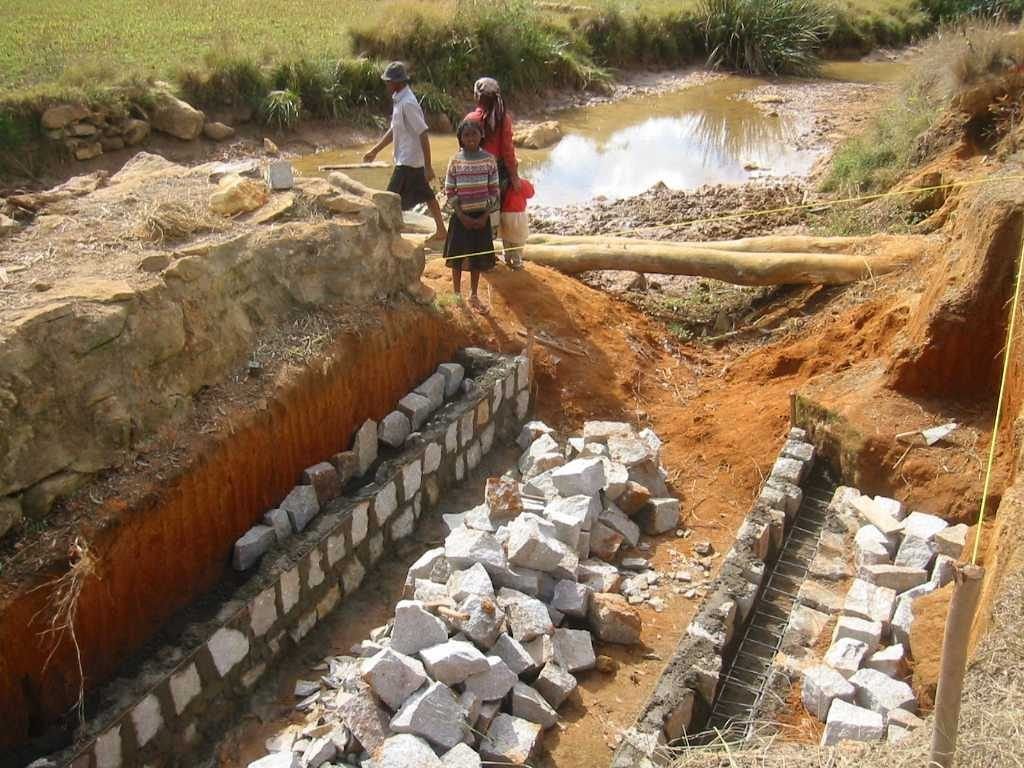
This is the date that will be carved on the plaque. On site at 9.30am. About fifty people, young and old — and one single shovel. Areas are marked out and dug, a temporary crossing is laid 50 cm above the water, and concrete is poured at about 4pm.
I have to say that when I arrived this morning, I never thought we would be this far by four in the afternoon.
6 — 7 AugustThe piers rise
The roadside pier reaches one metre of the 1.80 planned; the central pier rises thirty-five centimetres, reinforcement laid and poured. Gravel and sand arrive. And the realisation lands: they will be at least ten bags of cement short. The bill grows.
8 AugustOne village walks away
Five bags of cement carried on the roof of a bush taxi; one of them, 50 kg, splits open over Gilles as it is unloaded. Six masons are working. But one of the three villages stops sending labour, and the sand is not arriving.
This evening I lost my temper, so that it gets sorted out — otherwise I shut up shop.
That same evening, a first load of sand appears.
9 AugustTwo thousand stones
250 kg of cement loaded onto a Peugeot van ‘with forty-two years of service’. The villagers, for their part, had worked until 9.30 the night before: 2,000 stones carried, plus 130 very large ones, two cubic metres of gravel, and sand.
They even added that they had not slept much — my remarks had caused a stir in the villages.
A spring wells up beneath the fourth pier: the excavation has to be bailed out by bucket. A snake passes by before lunch.
11 — 12 AugustThe beams and the forest
The two steel beams are negotiated: 500,000 ariary, about €210, 320 kg each. Loaded in the evening by eight men into a lorry lent free of charge by the president's brother-in-law, a joiner in Antsirabe.
The next day the lorry stops 150 m short of the bridge: the beams are carried the rest of the way by ‘twenty good men’. Then an expedition into the forest with some thirty people: five trunks felled, stripped and hauled out by hand. Five times over. On the way back, a police roadblock and a 10,000-ariary bribe.
13 AugustLaying the beams
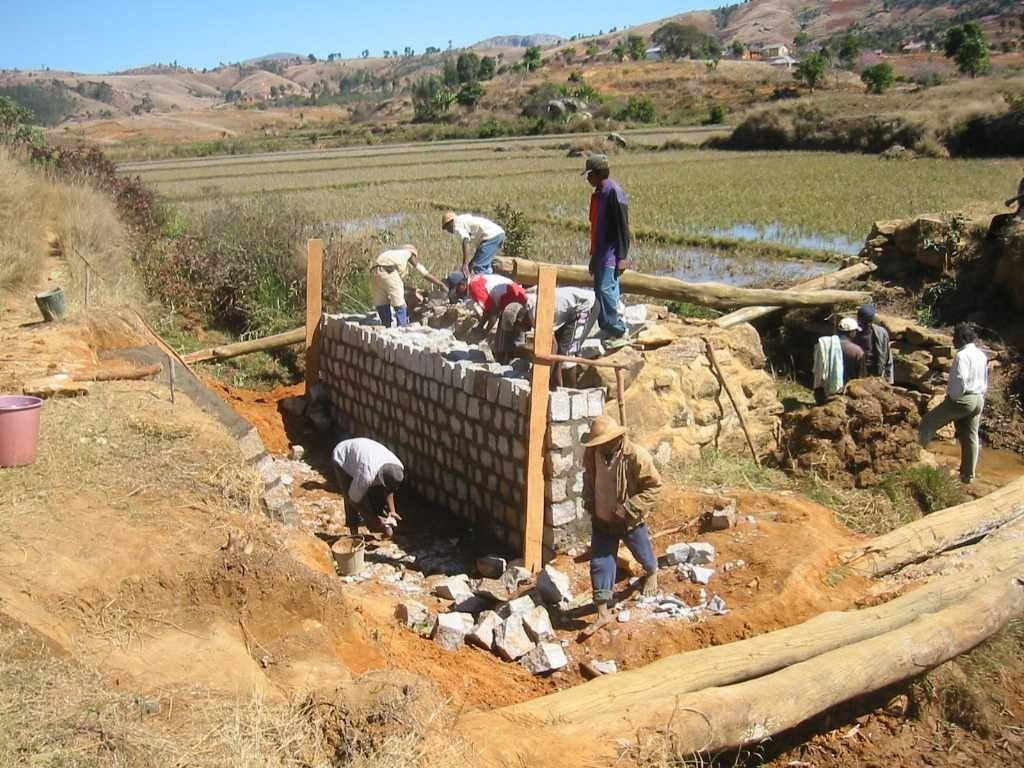
The trunks are cut to length, shaped with an axe, and laid between the first two piers. The five beams go into place.
To round off the laying of the beams, a group of villagers came in costume to play music and sing, and we had to dance on the concrete central pier.
By evening, most of the decking of the first span is down.
15 August"The bridge is finished"
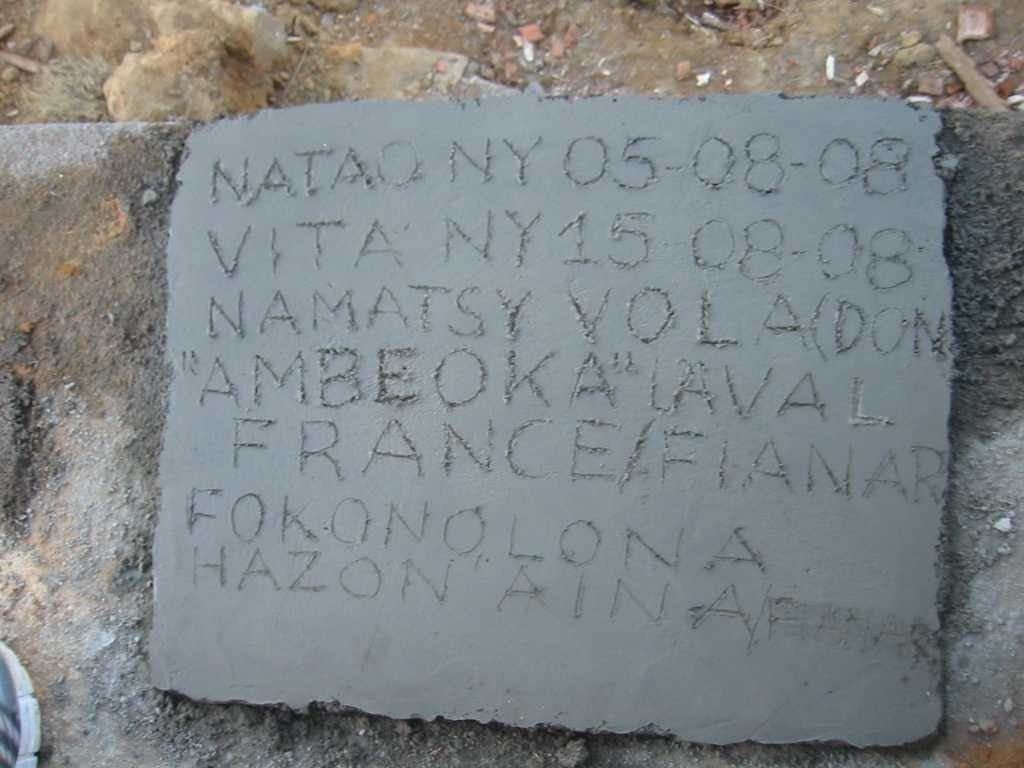
All the decking is laid between the last two piers, the ten beams set in concrete. The masons leave the site. The plaque is carved:
Works started 5/08/08 — Works completed 15/08/08 — Gift of AMBEOKA Laval France.
16 AugustAn empty site
Nobody there. The villagers, who are Adventists, had simply lost track of what day it was.
He stepped forward, taking off his hat, to apologise and ask my forgiveness. He had not remembered that today was Saturday.
19 AugustOn the radio
A last visit for some time. The work asked for has been done, apart from the approaches. A journalist from Radio Mampita interviews Gilles beside the bridge — and that is where it is given its name, "the Friendship Bridge". The programme airs on 30 August.
23 AugustThe accounts
A month to the day since leaving France. Gilles totals it up: the bridge has cost about €1,750, tools included, against the €1,100 planned. The fourth pier was far more damaged than reported, the first did not exist at all, and the reference quotation dated from April 2006.
The zebus have already crossed the bridge.
8 SeptemberLashing the deck
Back on the bridge with galvanised wire, to lash down the running boards. Dizziness in the sun.
My shorts gave up the ghost this morning doing the splits to reach the lashings under the bridge. I came home with my underwear on display, which greatly amused the ladies in the bush taxi.
28 SeptemberThe eve
Preparations: ditches cleared, the pool cleaned, a shelter of branches built for the officials, posts and ribbon set up. The kitchens work until midnight. The food collection is disappointing in two of the three villages — the chief of one of them has just died.
29 SeptemberThe opening
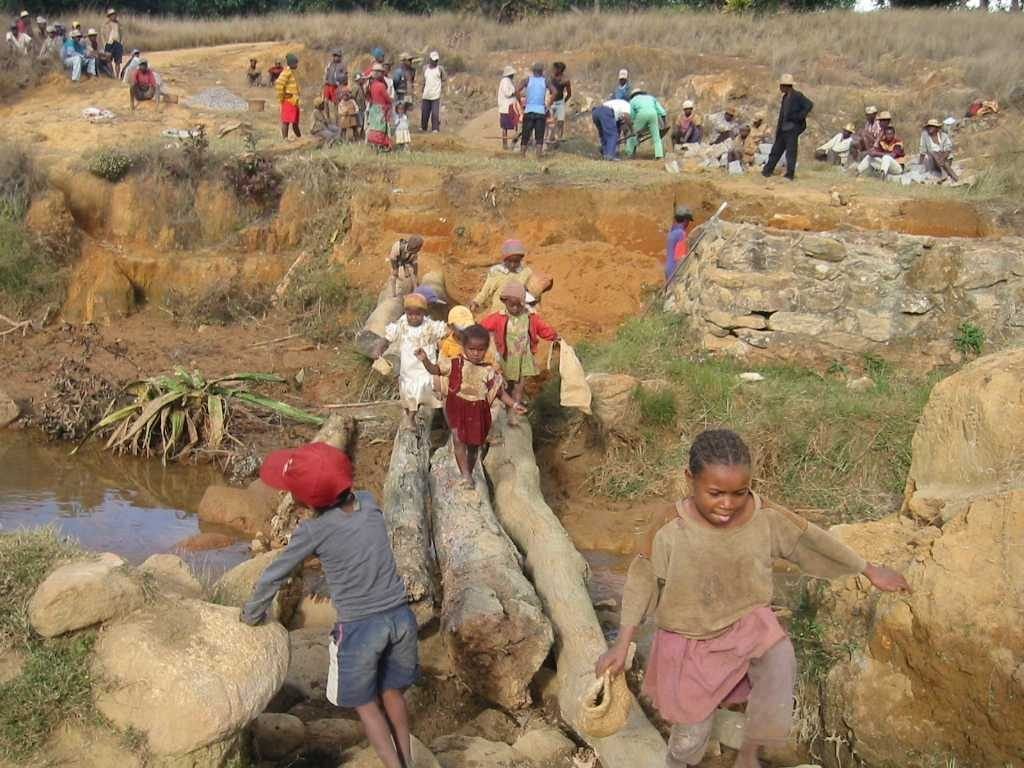
Up at 5am, at the bridge by 9.30. Schoolchildren raise the Malagasy flag. A minute's silence for the village chief who has died. Speeches from the mayor, from the president of AMBEOKA Fianarantsoa, from Gilles — translated into Malagasy by the head of the school — from the member of parliament and from the district chief. Then the ribbon is cut.
Around fifty invited guests, and two hundred people packed in opposite. The gifts: two raffia hats and a wall hanging embroidered "Long live Ambeoka Laval France".
Handing out sweets to the children had the effect of a flock of starlings dropping into a wheat field — everything vanished in no time.
The build in figures
1,500 of them 50 to 100 kg
against the 25 bought at the outset
a kilometre away
hauled out of the forest
one of them built from nothing
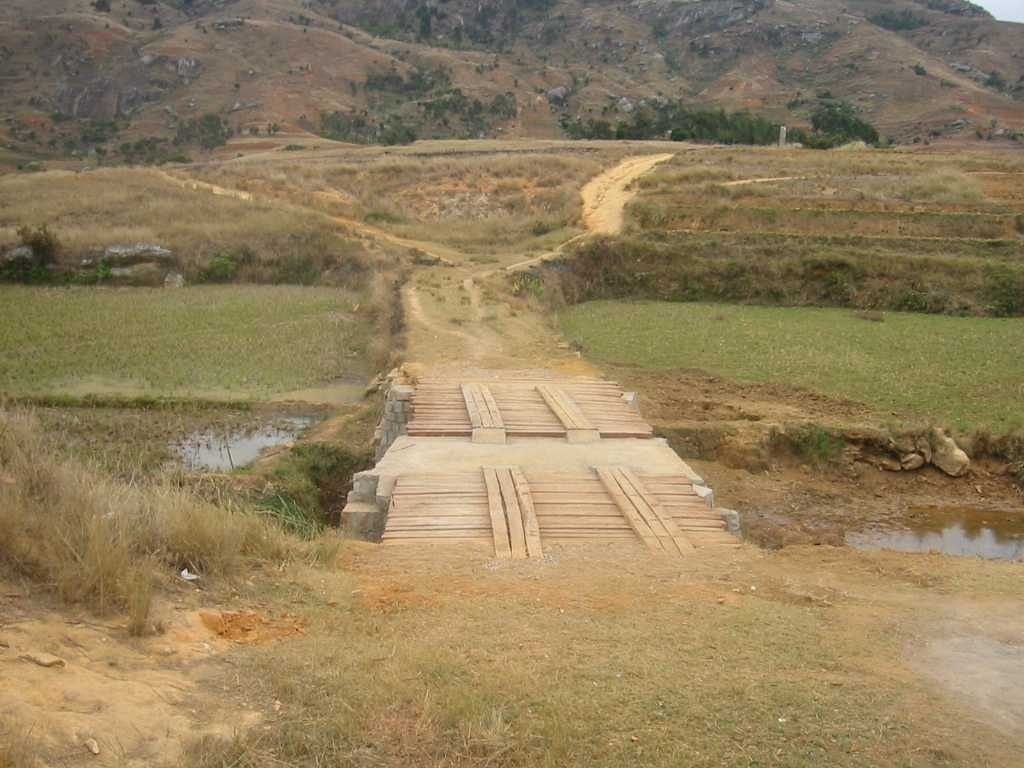
The deck rests on two steel beams, 5.20 m long and 320 kg each, together with timber beams cut from the trunks hauled out of the forest — ten in all, set in concrete. Over them, 62 eucalyptus beams four metres long form the decking. Add 7 m³ of gravel and 10 kg of nails.
The bridge was designed to carry five-tonne lorries. During cyclones, the water rises by two metres.
Final cost: about €1,750, tools included, on a mission budget of €1,930 closed with an €18 shortfall. Gilles flew home on 4 October 2008. He had lost 13 kg.
About these sources. This page draws on the reports Gilles wrote on site between July and October 2008, held in our archives. The quotations are translated from his own words.
Reports 1 to 6 are missing, which leaves the first week of August without a direct account. The plaque set into the bridge records the work as running from 5 to 15 August: the villagers had in fact begun on 26 July, and finishing work continued into September. The village name is spelled four different ways across the documents, and the river is never named.
The bridge is still in use
€1,750. That is what it cost to reconnect three villages. Your donations fund the next project.
Make a donation